
2026 FIFA World Cup Housing Crisis: 5 Steps to Secure Dallas Accommodation Before It's Too Late (Easy Guide for Visitors)
- Cindy Palanca
- Jan 7
- 24 min read

The 2026 FIFA World Cup is shaping up to be the biggest sporting event in North American history. With 48 teams competing across 16 host cities and an estimated 6.5 million visitors expected, the accommodation landscape is already looking tight, especially in Dallas.
Here's the reality: Dallas is one of the most sought-after host cities, and the numbers don't lie. More than 380,000 guests are expected to book accommodations through major platforms during the tournament. Add to that the fact that Dallas has been actively enforcing short-term rental bans (removing roughly 7,000 properties from the market), and you've got a perfect storm of high demand and limited supply.
But don't panic. If you act smart and act fast, you can still secure great accommodations for your World Cup experience in Dallas. Here's your step-by-step playbook.
Step 1: Book Through Official Channels First (Start Now, Not Later)
Airbnb is the official accommodation partner for FIFA World Cup fans, and they're rolling out a $5 million "Host City Impact Program" specifically for the tournament. This partnership means they'll have priority access to properties and special programs designed for World Cup visitors.
What you should do:
Set up alerts on Airbnb for Dallas properties during your planned dates
Join their World Cup accommodation waitlists if available
Follow their official World Cup housing updates
Why this matters: As the official partner, Airbnb will likely have the largest inventory of available properties, plus they're investing heavily in ensuring a good experience for World Cup guests.

Step 2: Cast a Wide Net with Your Location Search
Dallas is a sprawling metropolis, and being flexible with your location can be the difference between finding accommodation and being shut out entirely. Don't just focus on downtown Dallas, expand your search radius.
Smart neighborhoods to consider:
Uptown/Deep Ellum: Close to nightlife and dining, good public transport connections
Plano/Richardson: Suburban feel, more inventory, easier driving access to stadiums
Arlington: Closer to AT&T Stadium, plenty of hotel options
Fort Worth: Part of the greater Dallas metro, often overlooked but well-connected
Pro tip: Look for properties within 30-45 minutes of AT&T Stadium (where matches will be held) rather than limiting yourself to Dallas proper. You'll find more options and potentially better prices.
Step 3: Consider Corporate Housing as Your Secret Weapon
While everyone else is fighting over hotels and Airbnb listings, consider corporate housing providers like PBD Living. These fully-furnished, mid-term rental specialists often have inventory that doesn't show up on traditional booking platforms.
Why corporate housing works for World Cup visitors:
Flexible booking terms: Many can accommodate stays from a few days to several weeks
Fully equipped: Unlike hotels, you get full kitchens, washer/dryer, and home-like amenities
Better value: Often more cost-effective than hotels for stays longer than 3-4 nights
Less competition: Most fans don't think to look at corporate housing options
How to approach it: Contact providers directly and explain your World Cup dates. Many can create custom packages for the tournament period.

Step 4: Build Your Backup Plan (Multiple Reservations Strategy)
Given the uncertainty around availability and pricing, you need a layered approach. Book multiple options with flexible cancellation policies, then narrow down as the tournament approaches.
Your backup plan should include:
Primary choice: Your ideal accommodation (location, price, amenities)
Secondary option: A slightly less ideal but acceptable alternative
Emergency backup: Something further out or more expensive, but guaranteed
Timing strategy:
12+ months out: Book your primary choice, even if prices seem high
6-8 months out: Secure your secondary option
3-4 months out: Lock in your emergency backup
1-2 months before: Cancel the options you don't need
Important: Only book accommodations with free cancellation policies until 24-48 hours before check-in. This gives you maximum flexibility.
Step 5: Prepare for Premium Pricing (And Budget Accordingly)
Let's be honest about what you're facing: accommodation prices during the World Cup will be significantly higher than normal Dallas rates. Industry experts are predicting price increases of 200-400% in host cities.
What to expect:
Hotels: Standard rooms that normally cost $120-150/night could reach $400-600/night
Short-term rentals: Expect 3-5x normal pricing for prime locations
Corporate housing: Often the best value proposition, but still 2-3x normal rates
Budget-smart strategies:
Split accommodations: Consider staying further out for part of your trip, closer in for match days
Group bookings: Rent larger properties with friends/family to split costs
Extended stays: Sometimes booking for a longer period results in better per-night rates

The Dallas-Specific Reality Check
Dallas presents unique challenges that other host cities don't face. The city has been cracking down on short-term rentals, removing an estimated 7,000 properties from the market. This was partly driven by housing affordability concerns for local residents, but it directly impacts visitor accommodation options.
What this means for you:
Fewer Airbnb options: The pool of available short-term rentals is smaller than in other major cities
Higher hotel demand: With fewer rental options, hotels will see even more pressure
Corporate housing advantage: Professional housing providers are less affected by these restrictions
Your Action Plan Starts Now
The window for securing good World Cup accommodations in Dallas is closing fast. Every month you wait, your options become more limited and expensive.
This week:
Research neighborhoods and set your location priorities
Contact 3-5 accommodation providers (including corporate housing options)
Set up alerts on major booking platforms
This month:
Make your first booking with flexible cancellation
Join World Cup accommodation mailing lists
Start building your backup options
The 2026 World Cup will be an incredible experience, but only if you have a place to stay. Dallas is going to be amazing, crowded, electric, and absolutely packed with football fans from around the world.
Don't let accommodation stress ruin your World Cup experience. Start your search today, cast a wide net, and remember that sometimes the best options are the ones everyone else isn't thinking about. Whether that's a corporate housing unit in Plano or a perfectly located rental in Deep Ellum, your perfect World Cup base is out there, you just need to find it before everyone else does.
Mid-Term Rentals vs Hotels vs Airbnb: Which Is Better For Your 30+ Day Dallas Stay?
Planning an extended stay in Dallas? Whether you're relocating for work, handling a lengthy project, or just wanting to experience Dallas life for a month or more, choosing the right accommodation can make or break your experience.
The 30+ day sweet spot is where things get interesting. You're past the point where hotels make financial sense, but you're also looking at something more substantial than a typical vacation rental. Let's break down your three main options and help you make the smartest choice for your situation.
The Real Cost Breakdown: What You'll Actually Pay
Let's start with the numbers, because your wallet is probably your biggest concern.
Hotels (Extended Stay Chains)
Average cost: $1,800-2,800/month for extended stay hotels
What's included: Housekeeping, utilities, basic breakfast, gym access
Hidden costs: Parking ($10-15/day), laundry, premium WiFi, meals beyond breakfast
Real monthly cost: $2,200-3,500+
Airbnb (Monthly Rates)
Average cost: $1,500-3,500/month depending on location and size
What's included: Varies wildly by host
Hidden costs: Cleaning fees, service fees, utilities (sometimes), parking, furnishings/supplies
Real monthly cost: $1,800-4,200+
Corporate/Mid-Term Rentals
Average cost: $2,000-3,200/month for furnished units
What's included: Full furnishing, utilities, housewares, linens, parking
Hidden costs: Minimal, usually just personal items and food
Real monthly cost: $2,000-3,400
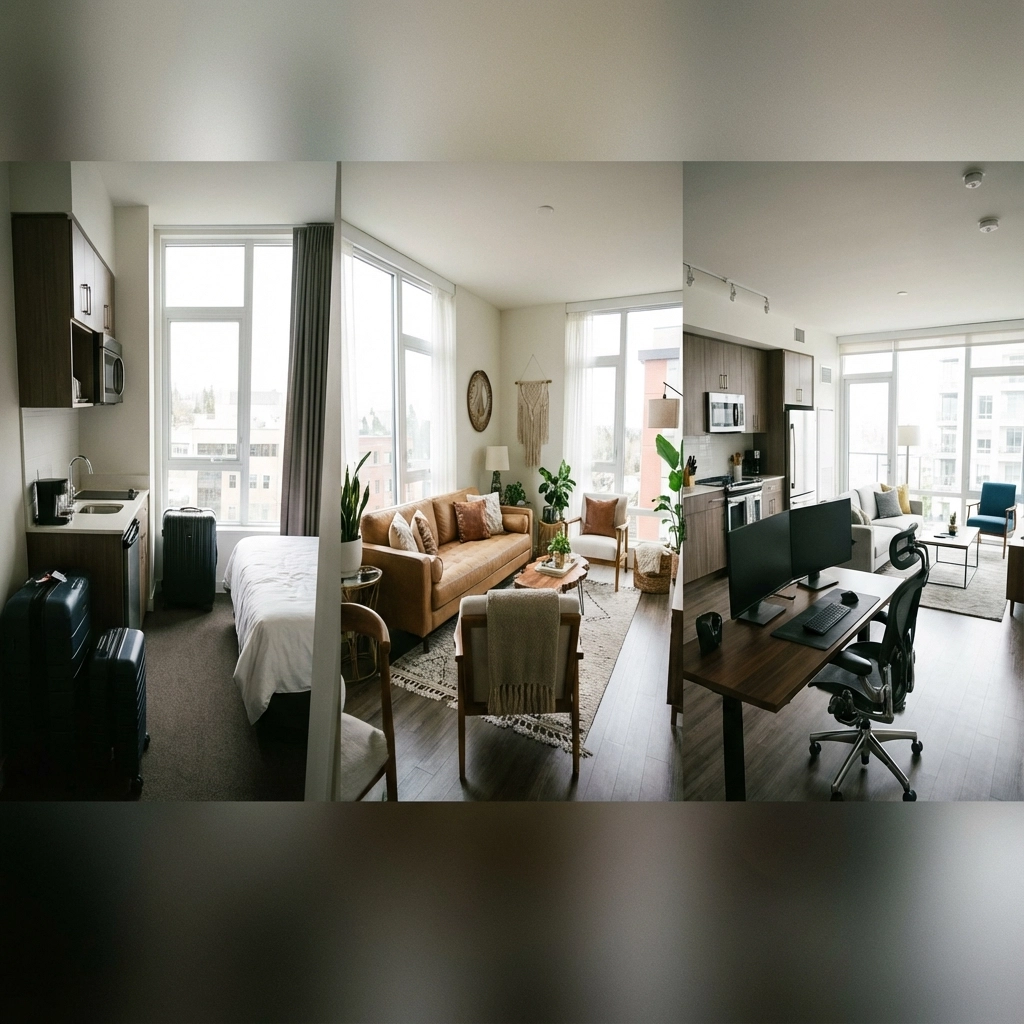
Space and Comfort: What Your Daily Life Actually Looks Like
Hotels: The Shrinking Room Reality Even "extended stay" hotels typically offer 300-400 square feet. You're looking at a small kitchenette, limited storage, and zero personal space. After week two, you'll feel like the walls are closing in.
Airbnb: The Wild Card Airbnb properties run the full spectrum. You might get a spacious 2-bedroom house or a cramped studio that's nothing like the photos. The challenge? You can't really know until you're there, and changing accommodations mid-stay is expensive and stressful.
Corporate Housing: Built for Living Most corporate housing offers 600-1,200+ square feet with separate living areas, full bedrooms, and complete kitchens. These are designed for people who need to actually live somewhere, not just sleep.
The Kitchen Factor (More Important Than You Think)
After 30 days, having a real kitchen becomes crucial: both for your budget and your sanity.
Hotel kitchenettes usually mean a mini-fridge, microwave, and maybe a hot plate. You'll be eating out constantly or surviving on microwaved meals.
Airbnb kitchens are hit-or-miss. Some hosts provide fully stocked kitchens with quality cookware; others give you mismatched pots and a broken can opener. Plus, you might need to buy basics like salt, oil, and spices.
Corporate housing kitchens come fully equipped with quality appliances, cookware, dishes, and basic pantry items. You can actually cook real meals from day one.

Work-From-Home Reality Check
If you're working remotely during your stay (and let's be honest, most month-long stays involve work), your accommodation choice becomes even more critical.
Hotels: Limited workspace, inconsistent WiFi, no printer access, and constant interruptions from housekeeping. Not ideal for productivity.
Airbnb: Some have great home offices; others expect you to work from the kitchen table. WiFi quality is completely unpredictable, and there's usually no backup plan if it fails.
Corporate Housing: Purpose-built for business travelers with dedicated workspace, reliable high-speed internet, and often printer/office supply access.
The Flexibility Question
Life happens, especially during month-long stays. Projects get extended, plans change, and flexibility becomes valuable.
Hotels: Usually easy to extend, but you're locked into the same rate structure and room type.
Airbnb: Extending can be complicated and expensive. Many hosts have back-to-back bookings, making extensions impossible.
Corporate Housing: Built for flexibility. Most providers can easily accommodate extensions, date changes, or even unit upgrades as needed.
Location Strategy: Where You Stay Matters
Hotels cluster around airports, highways, and business districts. You'll have consistent chain amenities but limited neighborhood character.
Airbnb offers the widest location variety, from downtown lofts to suburban homes. But prime locations get booked fast, especially for month-long stays.
Corporate housing providers like PBD Living strategically place properties in business-friendly neighborhoods with easy commute access, shopping, and dining nearby.

The Service and Support Reality
When you're staying somewhere for a month, problems will arise. How those problems get solved makes a huge difference.
Hotels: 24/7 front desk support, but limited ability to solve non-standard problems. Need a different room layout? Tough luck.
Airbnb: Support depends entirely on your host. Some are incredibly responsive; others disappear after check-in. Airbnb's customer service for month-long stays can be frustratingly slow.
Corporate Housing: Professional property management with local teams who understand business travelers' needs. Problems get solved quickly because that's literally their business model.
The Social Factor (Especially for Solo Travelers)
A month is long enough to get lonely, especially if you're traveling solo for work.
Hotels: Limited social opportunities beyond the lobby or gym. You're surrounded by short-term guests who aren't looking to make friends.
Airbnb: Depends on the setup. Entire homes offer privacy but isolation; shared spaces with hosts can provide local connection.
Corporate Housing: Often located in buildings with other extended-stay professionals, creating natural networking opportunities.
Tax Implications (The Boring but Important Stuff)
For business travelers, tax treatment differs significantly:
Hotels: Straightforward business expense deduction.
Airbnb: Can be more complicated, especially if the stay includes non-business days.
Corporate Housing: Structured as business accommodations with proper documentation for expense reporting.
Making Your Decision: A Simple Framework
Choose Hotels if:
You want minimal decision-making and maximum predictability
You're staying in one location with no transportation needs
You don't mind eating out for most meals
You're comfortable in small spaces
Choose Airbnb if:
You want the most location variety and local experience
You're comfortable managing potential issues yourself
You have time to research and vet properties thoroughly
You don't mind buying household supplies and basics
Choose Corporate Housing if:
You need to be productive during your stay
You want a true "home away from home" experience
You value professional support and service
You need flexibility for potential date changes

The Bottom Line for Dallas Specifically
Dallas is a sprawling city where location really matters. Traffic can be brutal, so choosing accommodation near your main activities is crucial.
For most month-long Dallas stays, corporate housing offers the best combination of value, comfort, and convenience. You get the space and amenities of a home, the service level of a hotel, and pricing that's competitive with quality Airbnb options: without the uncertainty.
Hotels work if you're staying near the airport or a specific business district and don't mind the space limitations. Airbnb can be great if you find the right property, but the month-long booking process is more complicated and risky than shorter stays.
Whatever you choose, book early. Dallas's corporate housing and quality month-long rentals fill up quickly, especially during peak business seasons. Your extended stay experience starts with making the right accommodation choice: choose wisely, and your month in Dallas will be productive, comfortable, and maybe even enjoyable.
Traveling Nurse Housing Mistakes: 7 Things You're Doing Wrong in Dallas (And How to Fix Them)
As a traveling nurse, your housing choice can make or break your assignment. After talking to hundreds of healthcare professionals on Dallas assignments, we've identified the most common: and costly: mistakes that traveling nurses make when securing accommodation in the Dallas area.
These aren't just minor inconveniences. We're talking about mistakes that cost nurses thousands of dollars, add hours to daily commutes, or create living situations so stressful they impact job performance. The good news? Every single one is preventable.
Mistake #1: Choosing Location Based on Hospital Address Alone
What you're doing wrong: You Google your hospital's address, find housing nearby, and think you're set.
Why this backfires: Dallas traffic is notoriously complex, with multiple highway systems, toll roads, and time-sensitive traffic patterns. That apartment that looks "close" on Google Maps might require a 45-minute commute during shift changes.
The fix:
Test your actual commute times using Google Maps during your shift hours (not just general "rush hour")
Consider multiple routes to and from the hospital: construction and accidents are common
Factor in shift differentials: day shift vs. night shift traffic patterns are completely different
Ask current staff at your assigned hospital about the best neighborhoods for commuting
Real example: One nurse took housing in Addison because it looked close to Presbyterian Hospital Dallas. She didn't realize her night shifts would end right during morning rush hour, turning a 15-minute Google Maps route into a 50-minute nightmare commute.

Mistake #2: Underestimating the True Cost of "Cheaper" Options
What you're doing wrong: You see a lower base rent and jump on it without calculating total monthly expenses.
Why this costs you: Dallas's "affordable" housing often comes with hidden costs that quickly add up to more than higher-quality, all-inclusive options.
Hidden costs that kill your budget:
Parking fees: $50-150/month in most Dallas areas
Utilities setup and deposits: $200-400 upfront, plus monthly bills
Internet installation: $100-200 setup, $60-120/month
Basic furnishing needs: Even "furnished" places often lack basics like proper bedding, kitchen supplies, or workspace setup
Application fees and deposits: Multiple properties = multiple fees
The fix:
Calculate all-in monthly costs for any housing option
Consider corporate housing that includes utilities, parking, WiFi, and quality furnishings
Factor in your time value: spending weekends shopping for household basics isn't free
Real math: A $1,200/month apartment becomes $1,650/month after parking, utilities, internet, and furnishing costs. Meanwhile, a $1,800/month corporate housing unit with everything included saves you $50/month and countless hours.
Mistake #3: Ignoring Hospital-Specific Parking Situations
What you're doing wrong: You assume you can park at the hospital or nearby without researching the actual parking reality.
Why this matters: Dallas hospitals have widely varying parking situations, from free employee lots to expensive valet-only options. This directly impacts where you should live.
Hospital parking realities:
Baylor Scott & White: Generally good employee parking, but specific campuses vary
UT Southwestern: Limited parking, expensive visitor rates, but decent employee options
Presbyterian Hospital locations: Mixed: some have great employee lots, others are downtown with premium parking costs
Children's Health: Usually good employee parking but can be competitive during peak hours
The fix:
Ask your recruiter about specific hospital parking policies and costs
Contact the hospital's HR department directly about employee parking
Factor parking costs into your housing location decisions
Consider housing with guaranteed parking if hospital parking is limited or expensive
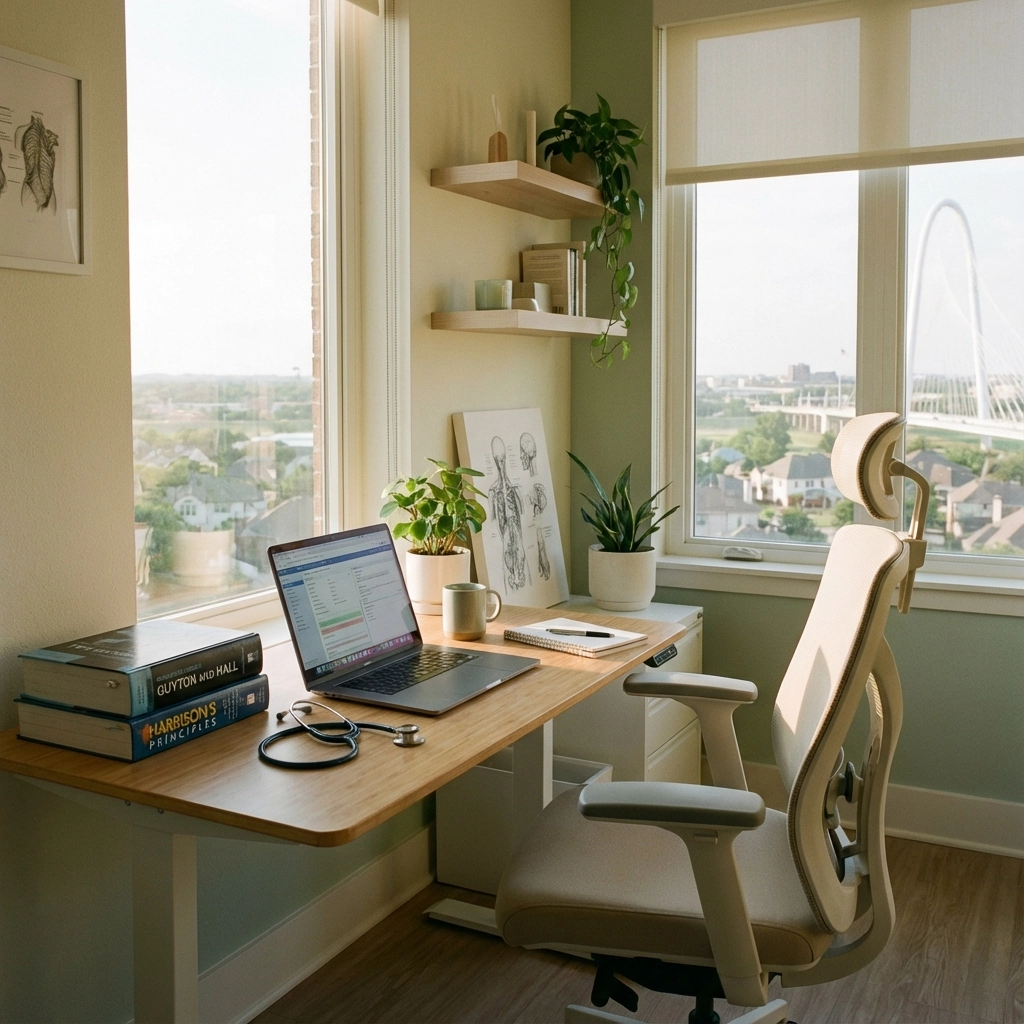
Mistake #4: Not Understanding Dallas Weather Impact on Housing
What you're doing wrong: You choose housing without considering how Dallas weather will affect your daily life.
Why this matters: Dallas has extreme weather: blazing summers, ice storms, and severe thunderstorms. Your housing choice needs to handle these realities.
Weather-related housing considerations:
Summer survival: AC costs can easily hit $200-300/month in cheap apartments with poor insulation
Ice storm preparation: Ground-floor units with covered parking become crucial during winter weather events
Flooding concerns: Parts of Dallas flood regularly: research flood zones before committing
Storm safety: Older apartments may lack proper storm shelters or safe areas
The fix:
Ask about utilities caps or average costs for summer months
Prioritize covered parking if available
Research the property's flood history and drainage situation
Consider newer construction with better insulation and storm resistance
Mistake #5: Signing Leases Without Understanding Texas Rental Laws
What you're doing wrong: You assume rental laws are the same everywhere and don't research Texas-specific tenant rights.
Why this hurts: Texas is generally landlord-friendly, with fewer tenant protections than many states. Knowing your rights prevents costly surprises.
Key Texas rental realities:
No rent control: Landlords can raise rent with proper notice
Security deposit rules: Landlords have specific timelines for returning deposits
Early termination: More restrictive than many states: breaking a lease can be expensive
Habitability standards: Different from other states you may have worked in
The fix:
Research Texas tenant rights before signing anything
Negotiate early termination clauses for assignment changes
Document everything when you move in and out
Consider corporate housing with more flexible terms designed for traveling professionals
Mistake #6: Failing to Plan for Assignment Extensions or Changes
What you're doing wrong: You plan housing for your initial 13-week assignment without considering what happens if you want to extend or need to leave early.
Why this creates problems: Assignment changes are common in travel nursing, and your housing choice should accommodate flexibility.
Common scenarios that derail housing plans:
Assignment extensions: Your apartment lease might not align with extended assignment dates
Early assignment completion: You're stuck paying rent after you've already moved to your next assignment
Assignment cancellations: Rare but devastating if you're locked into long-term housing costs
Family emergencies: You need to leave Dallas immediately but can't break your lease
The fix:
Negotiate month-to-month options after initial lease periods
Choose providers experienced with traveling healthcare workers
Build flexibility into your housing contracts
Consider providers who offer multi-location options if you work with the same agency
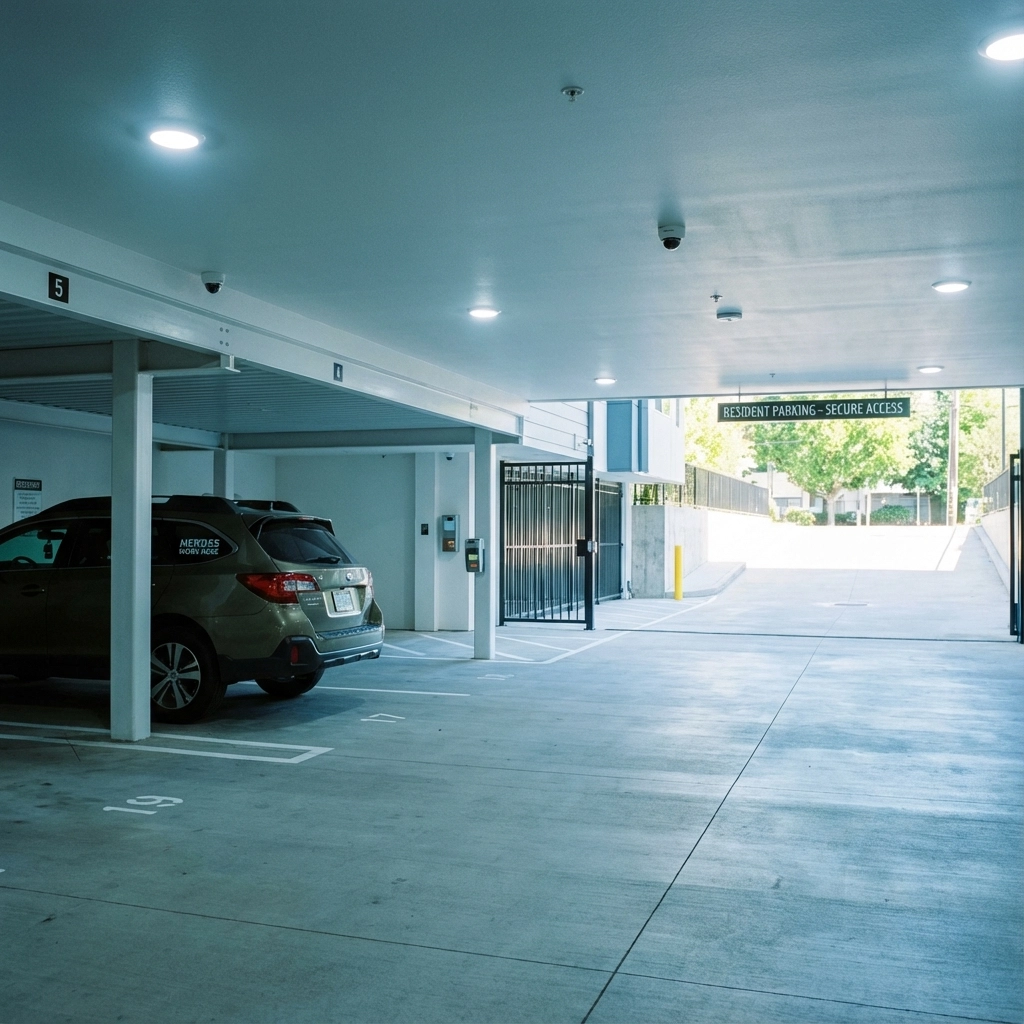
Mistake #7: Not Researching Neighborhood Safety and Lifestyle Fit
What you're doing wrong: You focus entirely on cost and location without researching what the neighborhood is actually like to live in.
Why this matters: As a traveling nurse, you're often working long, stressful shifts and need a safe, comfortable environment to recover. The wrong neighborhood choice affects your mental health and job performance.
Neighborhood research essentials:
Crime statistics: Not just general crime, but specific types (property crime vs. violent crime)
Noise levels: Are you near highways, airports, or entertainment districts?
Essential services: Grocery stores, pharmacies, urgent care within reasonable distance
Lifestyle match: Do you need nightlife, outdoor activities, quiet residential areas?
Dallas-specific neighborhood insights:
Uptown/Deep Ellum: Great nightlife but can be noisy and expensive
Plano/Richardson: Quieter, family-friendly, great for studying or rest
Arlington: Good hospital access, moderate cost, suburban feel
Downtown: Convenient for some hospitals but urban noise and homeless populations
The fix:
Visit neighborhoods at different times of day (especially your work shift times)
Read local crime reports and neighborhood apps
Talk to other healthcare workers about their Dallas neighborhood experiences
Prioritize safety and rest over trendy locations: you're here to work, not vacation
The Solution: Think Like a Professional, Not a Tourist
The biggest mistake traveling nurses make is approaching housing like they're planning a vacation instead of establishing a temporary professional base. Your housing choice directly impacts your work performance, financial goals, and overall assignment success.
Professional housing considerations:
Reliable internet for continuing education and communication with family
Proper workspace for charting, studying, or telehealth appointments
Kitchen facilities for healthy meal prep between shifts
Laundry access that fits your schedule
Parking security for your vehicle and belongings
Proximity to essential services like pharmacies, grocery stores, and healthcare
The corporate housing advantage: Companies like PBD Living specialize in housing for traveling professionals. They understand nurse schedules, provide flexibility for assignment changes, and include amenities that support your professional needs.
Your Action Plan for Smart Housing Decisions
Start your housing search early: ideally 6-8 weeks before your assignment
Calculate true monthly costs for every option you're considering
Test commute times during your actual shift hours
Prioritize flexibility over minor cost savings
Choose providers who understand healthcare travel
Dallas can be an amazing city for traveling nurses, with excellent hospitals, competitive pay rates, and plenty to explore during your time off. But your housing choice sets the foundation for everything else. Make it count.
Don't let these common mistakes derail your Dallas assignment. Plan smart, research thoroughly, and choose housing that supports your professional goals rather than creating additional stress. Your future self (and your bank account) will thank you.
Relocating to Dallas? Here Are 10 Things You Should Know About Corporate Housing in 2025
Moving to Dallas for work? Whether it's a temporary assignment, corporate relocation, or new job opportunity, the housing decisions you make in your first few weeks can impact your entire Dallas experience.
Corporate housing has evolved significantly in recent years, especially in a dynamic market like Dallas. Gone are the days of sterile, overpriced hotel-style accommodations. Today's corporate housing landscape offers solutions that can actually improve your relocation experience while saving you time, money, and stress.
Here's what every relocating professional needs to know about corporate housing in Dallas right now.
1. Corporate Housing Is Now More Flexible Than Apartment Leases
The old assumption: Corporate housing requires long-term commitments and rigid contracts.
The 2025 reality: Most corporate housing providers now offer stays from 30 days to 12+ months with flexible extension options. Unlike traditional apartment leases, you can adjust your stay length based on how your work situation develops.
Why this matters for relocating professionals: You might not know exactly how long you need temporary housing. Maybe your permanent home purchase gets delayed, your family needs more time to relocate, or your work assignment gets extended. Corporate housing adapts to your timeline instead of forcing you into rigid lease terms.
What to look for: Providers who allow month-to-month extensions after an initial minimum stay (usually 30-90 days).

2. All-Inclusive Pricing Actually Saves Money (When You Do the Math Right)
The sticker shock: Corporate housing daily or monthly rates look expensive compared to apartment rent listings.
The reality check: When you factor in everything you actually need for temporary housing, corporate housing often costs less than the DIY approach.
Hidden costs of apartment hunting during relocation:
First month's rent + security deposits: $2,000-4,000 upfront
Utility setup and deposits: $300-600
Internet installation and equipment: $150-300
Basic furniture and household items: $1,000-3,000
Time cost: Hours spent shopping, waiting for installations, dealing with multiple vendors
Corporate housing includes: Furnished space, utilities, internet, parking, housewares, linens, and often gym access or concierge services.
Real example: A $2,400/month corporate housing unit vs. a $1,600 apartment that requires $3,500 in setup costs and furnishings. The corporate housing breaks even by month 2 and saves money from month 3 forward.
3. Location Selection Is More Strategic Than You Think
Common mistake: Choosing corporate housing based purely on proximity to your new office.
Smarter approach: Consider your entire life transition, not just your commute.
Strategic location factors:
Exploration base: Choose neighborhoods that let you easily explore different Dallas areas for permanent housing
Lifestyle match: Stay somewhere that reflects the kind of Dallas lifestyle you want long-term
Network building: Certain neighborhoods are better for meeting other professionals in your industry
Future commute testing: Use your temporary housing location to test different commute routes and times
Dallas-specific insight: Areas like Uptown or Deep Ellum offer great exploration potential and networking opportunities. Suburban areas like Plano or Richardson give you a taste of family-friendly Dallas living.
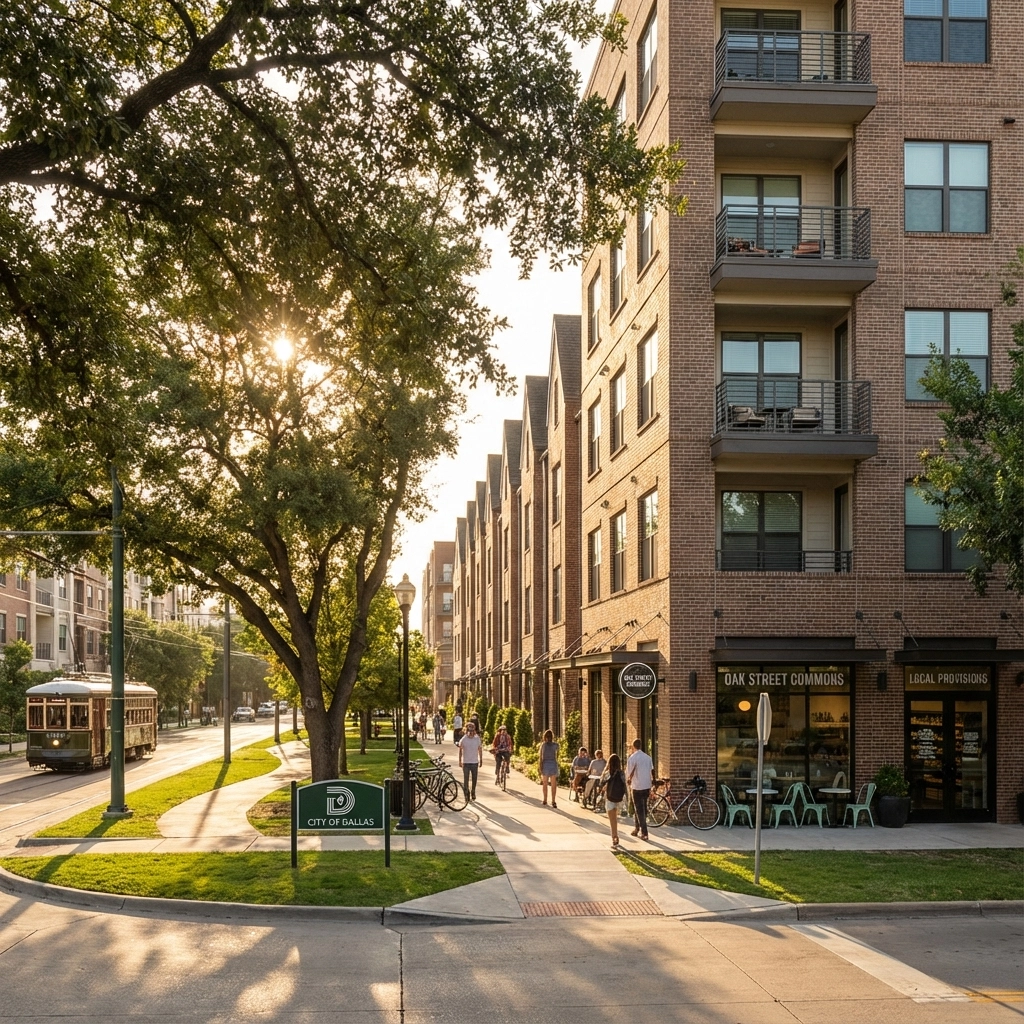
4. Corporate Housing Can Fast-Track Your Permanent Home Search
Traditional approach: Rush to find permanent housing while staying in extended-stay hotels or short-term apartments.
Strategic approach: Use corporate housing as your base for a thorough, pressure-free home search.
Advantages for home buying:
No rush decisions: You have a comfortable place to live while you explore neighborhoods
Local address: Some lenders and services prefer local addresses for applications
Storage and staging: Space to receive mail, deliveries, and coordinate moving services
Market knowledge: Time to understand Dallas real estate patterns and pricing
Advantages for apartment hunting:
Seasonal leverage: Wait for better lease deals (typically September-November in Dallas)
Thorough vetting: Actually visit multiple properties instead of choosing based on online photos
Negotiation time: Corporate housing gives you the luxury of walking away from bad deals
5. The Service Level Varies Dramatically Between Providers
Not all corporate housing is created equal. The difference between a good provider and a mediocre one can make or break your relocation experience.
Premium service indicators:
Local property management: On-site or nearby staff who can address issues quickly
24/7 support: Real people, not just answering services
Maintenance response: Same-day service for urgent issues, next-day for everything else
Concierge services: Help with everything from grocery delivery to restaurant recommendations
Red flags to avoid:
Remote-only management: No local presence when problems arise
Limited communication: Slow response to emails or calls
Basic furnishing: Cheap furniture that breaks easily or lacks comfort
Hidden fees: Charges for services that should be included
Questions to ask: "What happens if my internet goes out?" "How quickly do you respond to maintenance issues?" "Do you have staff in Dallas or just remote management?"
6. Technology and Workspace Features Are Now Essential
The remote work reality: Even if you're relocating for an office job, you'll likely need proper home workspace capabilities.
Must-have technology features:
Business-grade internet: Minimum 100+ Mbps download speeds with reliable uptime
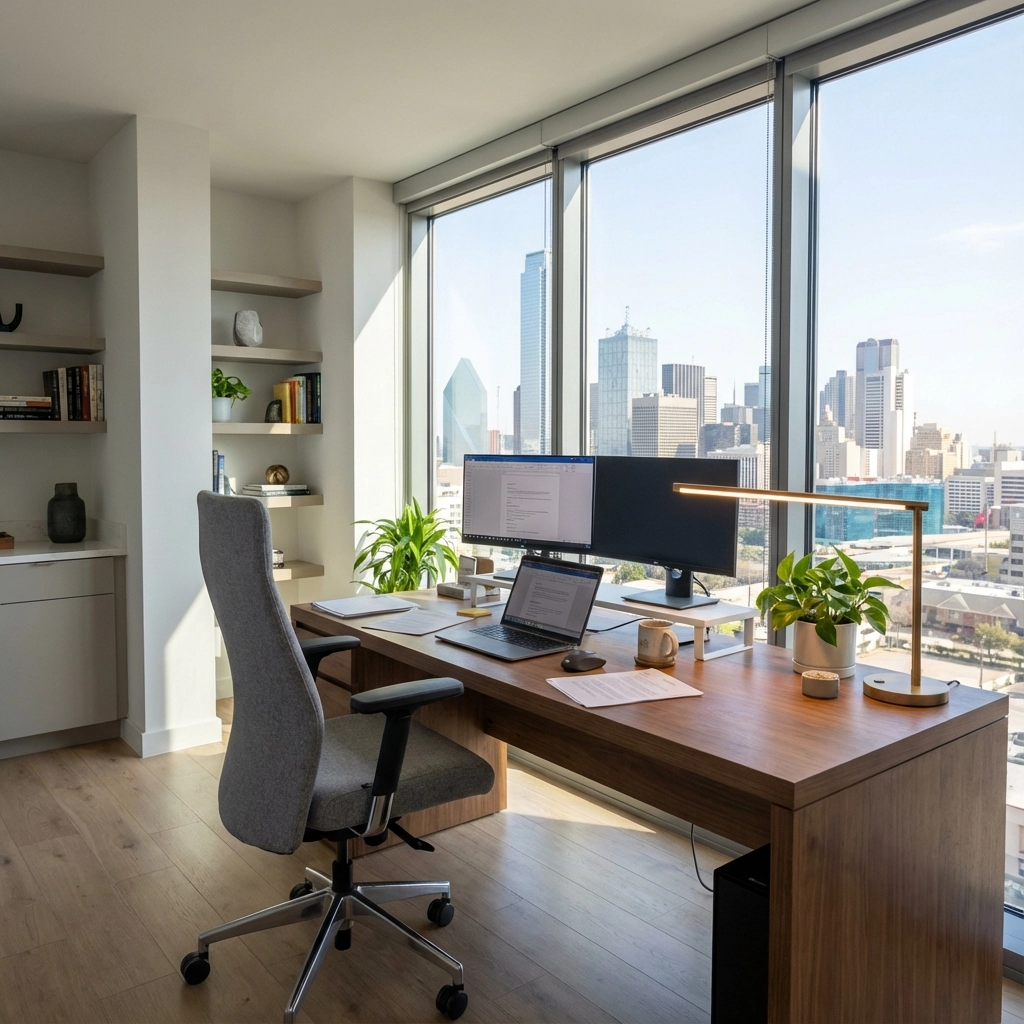
Dedicated workspace: Proper desk, ergonomic chair, good lighting
Multiple monitors or monitor-friendly setup: HDMI ports, adequate desk space
Video call environment: Good lighting, professional background options
Nice-to-have features:
Printer access: Either in-unit or building business center
Package receiving: Secure delivery handling for online shopping and work materials
Smart home features: Keyless entry, app-controlled thermostat, etc.
7. Corporate Housing Can Improve Your Social Integration
The isolation challenge: Relocating professionals often struggle with social connections in their new city.
How corporate housing helps:
Professional networks: Many corporate housing residents are other relocating professionals
Neighborhood integration: Unlike hotels, you're living in real neighborhoods where you can build local connections
Community amenities: Many buildings offer social events, fitness facilities, or co-working spaces
Maximizing social opportunities:
Choose buildings with other corporate housing residents
Join building amenities like gym classes or social events
Get involved in neighborhood activities near your corporate housing
8. Tax Benefits Are More Significant Than Most People Realize
For corporate relocations: Many corporate housing expenses are tax-deductible or reimbursable.
Key tax considerations:
Temporary work assignments: Housing costs may be fully deductible
Relocation expenses: Some corporate housing costs qualify as moving expenses
Business use: If you work from your corporate housing, portions may be deductible
Important: Consult with a tax professional about your specific situation, but corporate housing often offers better tax treatment than traditional apartment rentals for relocating professionals.
9. The Dallas Market Has Unique Advantages for Corporate Housing
Dallas-specific benefits:
Strong corporate presence: High demand keeps providers competitive and service-focused
Diverse neighborhoods: More location options than many other major cities
Business-friendly environment: Many providers cater specifically to corporate relocations
Reasonable costs: Generally less expensive than coastal cities for equivalent amenities
Market trends to know:
Growing inventory: New corporate housing options opening regularly
Technology integration: Dallas providers are early adopters of smart home and remote management tech
Extended stay specialization: Many providers focus specifically on 1-6 month stays
10. Choosing the Right Provider Can Set Up Your Entire Dallas Success
This isn't just about finding a place to sleep. The right corporate housing provider becomes your partner in relocation success.
What excellent providers offer:
Dallas area expertise: Neighborhood recommendations, commute advice, local insights
Relocation support: Help with everything from finding services to understanding local culture
Professional network: Connections to other services you might need (real estate agents, financial advisors, etc.)
Flexibility: Ability to adjust your arrangement as your situation changes
PBD Living advantage: As a Dallas-based corporate housing specialist, we understand the unique challenges of relocating to North Texas. Our properties are strategically located, our service is locally managed, and we've helped hundreds of professionals successfully transition to Dallas life.
Making Your Corporate Housing Decision
Your corporate housing choice isn't just about where you'll sleep for a few months: it's about setting up your entire Dallas transition for success. The right choice gives you a comfortable base, saves you money, and provides the flexibility to make smart long-term decisions about your Dallas life.
Questions to ask yourself:
How long might you realistically need temporary housing?
What neighborhoods do you want to explore for permanent housing?
What work-from-home capabilities do you need?
How important is service and support during your transition?
Next steps:
Research providers with strong Dallas presence and reviews
Calculate all-in costs compared to alternatives
Schedule virtual tours or in-person visits
Ask detailed questions about flexibility and service
Dallas is an incredible city for career growth, with a booming economy, reasonable cost of living, and genuine Texas hospitality. Your corporate housing choice can either support your success or create unnecessary stress during an already challenging transition.
Choose a provider who understands that corporate housing isn't just temporary accommodation: it's the foundation for your new Dallas life. Make it count.
Air Quality Matters: Why Environmental Monitoring Will Change the Way You Choose Corporate Housing
When was the last time you thought about the air you breathe in your temporary housing? If you're like most business travelers and relocating professionals, probably never. But that's about to change, and it could fundamentally reshape how you choose corporate housing.
Environmental monitoring technology is rapidly becoming a standard amenity in premium corporate housing, and early adopters are discovering it's not just a nice-to-have feature: it's a game-changer for health, productivity, and overall comfort during extended stays.
Here's why environmental monitoring matters more than you think, and how it's becoming the new standard for corporate housing quality.
The Hidden Health Impact of Poor Indoor Air Quality
The problem you can't see: Indoor air quality in temporary housing can be significantly worse than your permanent home, and you might not realize it until it affects your health and work performance.
Common indoor air quality issues in corporate housing:
VOCs (Volatile Organic Compounds): From new furniture, cleaning products, and building materials
Particulate matter: Dust, pollen, and pollution that infiltrates through HVAC systems
Humidity imbalances: Too dry (causing respiratory irritation) or too humid (promoting mold growth)
Carbon dioxide buildup: Poor ventilation in sealed buildings leads to stuffiness and cognitive impairment
The professional impact:
Decreased cognitive function: High CO2 levels can reduce decision-making ability by up to 50%
Sleep disruption: Poor air quality directly impacts sleep quality and recovery
Allergy and asthma triggers: Unknown environmental factors can worsen respiratory conditions
General fatigue: Poor air quality causes that "tired building" feeling

What Environmental Monitoring Actually Measures
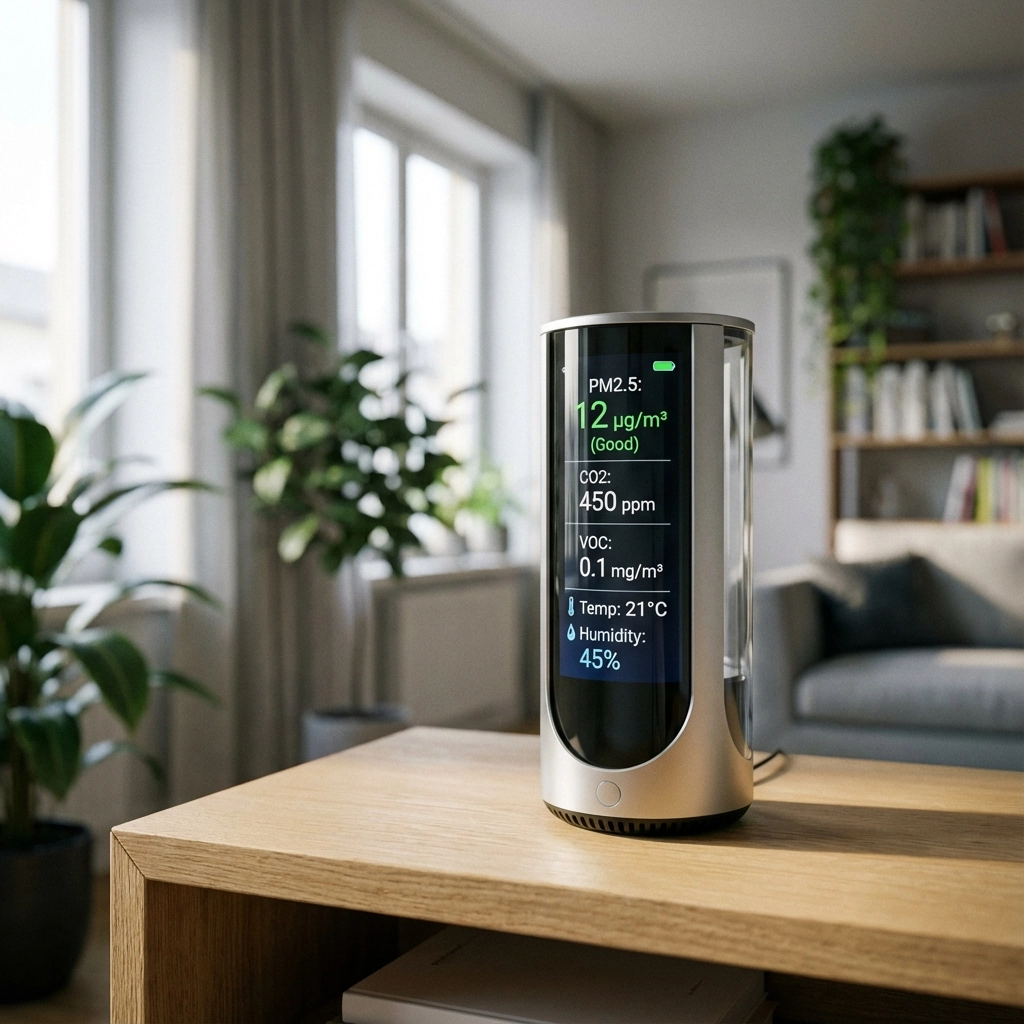
Modern environmental monitoring systems track multiple factors that directly impact your comfort and health:
Air Quality Metrics:
PM2.5 and PM10: Fine particulate matter that penetrates deep into lungs
VOC levels: Chemical emissions from furniture, paint, and cleaning products
Carbon dioxide: Indicator of ventilation effectiveness
Carbon monoxide: Safety monitoring for gas leaks or combustion issues
Comfort Metrics:
Temperature: Not just thermostat readings, but actual ambient temperature
Humidity: Optimal range is 30-50% for health and comfort
Air pressure: Changes can trigger headaches and discomfort
Additional Monitoring:
Noise levels: Decibel tracking for sleep and work quality
Light quality: Natural vs. artificial light ratios
Water quality: Some systems include tap water monitoring
The Technology Revolution in Corporate Housing
Smart sensors are getting smaller, cheaper, and more accurate. What used to require expensive professional equipment now fits in devices smaller than a smoke detector.
Current monitoring capabilities:
Real-time tracking: Continuous monitoring with smartphone app alerts
Historical data: Track patterns and identify trends over time
Automated responses: Some systems automatically adjust HVAC, air purifiers, or humidity controls
Professional reporting: Detailed reports for health-conscious travelers
Leading monitoring systems in corporate housing:
Awair: Consumer-friendly devices that track comprehensive air quality
IQAir: Professional-grade monitoring with detailed pollutant detection
Foobot: Continuous air quality monitoring with smart home integration
Custom building systems: Integrated monitoring throughout the entire property
Why This Matters More for Corporate Housing Than Regular Apartments
Corporate housing faces unique environmental challenges:
Higher turnover: More people moving through units means more potential contamination and faster wear on air filtration systems.
Furnished environments: New or frequently replaced furniture releases more VOCs than established, aired-out furnishings.
Sealed building syndrome: Many corporate housing buildings prioritize energy efficiency over air circulation.
Unknown history: You don't know what previous occupants did that might have affected air quality (smoking, pets, cooking habits, etc.).
Professional stakes: Poor air quality doesn't just affect comfort: it directly impacts your work performance and career success.
The Competitive Advantage for Forward-Thinking Providers
Corporate housing providers who invest in environmental monitoring are differentiating themselves significantly:
Health-conscious professionals: Increasingly prioritizing wellness amenities over luxury features.
Remote work optimization: As more professionals work from temporary housing, air quality directly impacts productivity.
Medical and pharma travelers: Industries with heightened awareness of environmental health impacts.
Long-term stays: The longer your stay, the more environmental quality impacts your overall experience.
Corporate health programs: Companies are beginning to consider environmental factors when selecting approved housing providers.
What Good Environmental Monitoring Looks Like in Practice
Real-time visibility: You can check current conditions via smartphone app or in-unit display.
Proactive alerts: Notifications when air quality drops below healthy levels, with recommendations for improvement.
Automatic adjustments: Smart HVAC systems that respond to air quality readings.
Historical reporting: Weekly or monthly reports showing air quality trends and improvements.
Professional response: Property management that takes air quality seriously and responds quickly to issues.
The Dallas-Specific Environmental Considerations
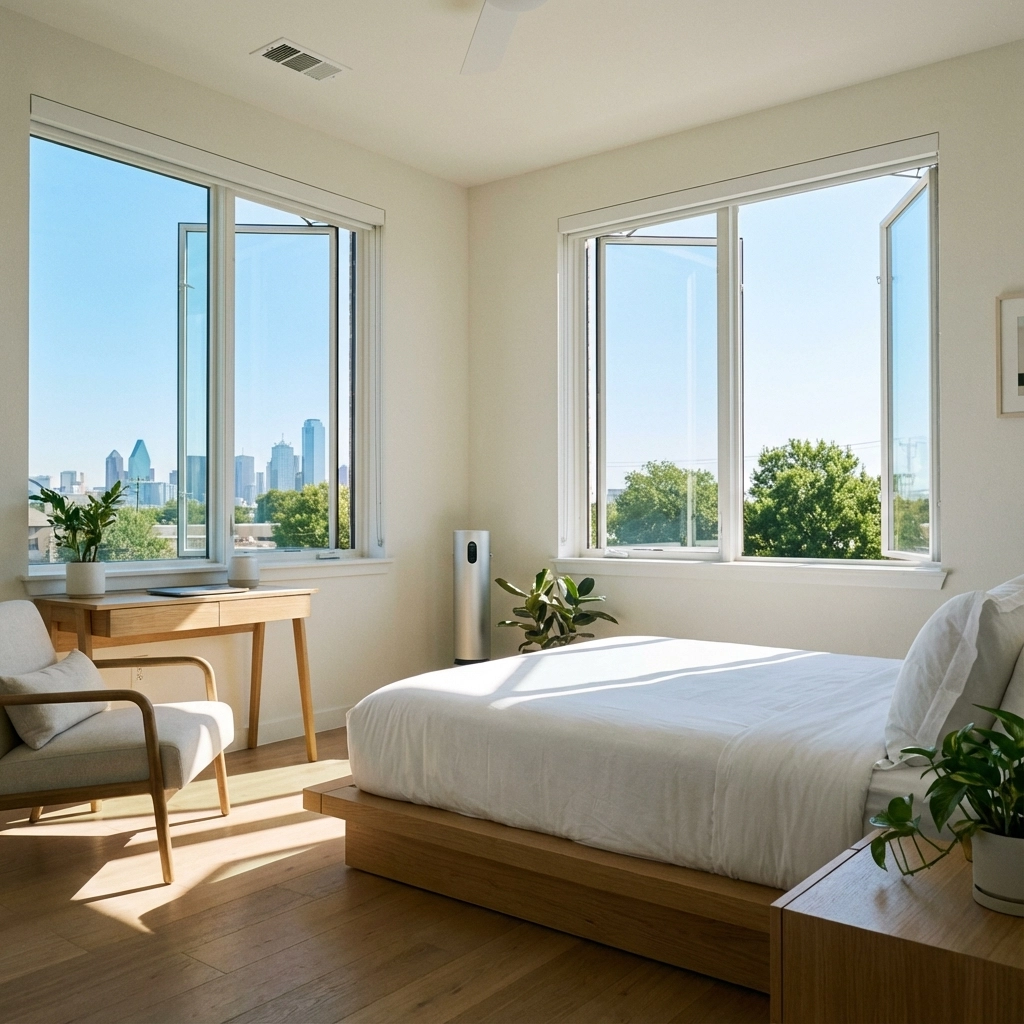
Dallas presents unique air quality challenges that make monitoring especially valuable:
Seasonal allergens: Cedar fever in winter, multiple pollen seasons throughout the year.
Urban air pollution: Traffic and industrial emissions, especially in certain corridors.
Weather extremes: High heat and humidity stress HVAC systems and air quality.
Construction boom: Ongoing development creates dust and particulate matter.
Wildfire smoke: Increasingly common seasonal issue affecting regional air quality.
Oil and gas activity: Regional industrial activity can impact local air quality.
How to Evaluate Environmental Monitoring When Choosing Corporate Housing
Questions to ask providers:
"What environmental monitoring systems do you use?"
"Can I access real-time air quality data during my stay?"
"How do you respond when monitoring indicates air quality issues?"
"What air filtration and purification systems are in place?"
Red flags to avoid:
No monitoring capability: Providers who haven't considered air quality at all
Basic thermostat-only: Temperature control without humidity or air quality consideration
No maintenance protocols: Systems without regular filter changes or calibration
Green flags to look for:
Multiple sensor types: Comprehensive monitoring beyond just temperature
Guest access: Ability to see your own environmental data
Proactive maintenance: Regular filter changes, duct cleaning, system updates
Response protocols: Clear procedures for addressing air quality issues
The Future of Environmental Monitoring in Corporate Housing
This technology is rapidly becoming standard, not premium. Within the next 2-3 years, environmental monitoring will likely be as common as WiFi in quality corporate housing.
Emerging trends:
AI-powered optimization: Systems that learn your preferences and automatically create optimal environments
Health integration: Monitoring that connects with fitness trackers and health apps
Predictive maintenance: Systems that predict and prevent air quality issues before they occur
Personalized environments: Individual room control based on occupant preferences and health needs
Making Environmental Monitoring Work for You
If your current corporate housing doesn't have monitoring:
Bring portable monitors: Devices like Awair Element or IQAir AirVisual provide personal monitoring
Request air quality information: Ask providers about their filtration and maintenance protocols
Monitor your own symptoms: Track sleep quality, energy levels, and respiratory comfort
If your housing does have monitoring:
Learn the system: Understand how to read and interpret the data
Set up alerts: Configure notifications for air quality changes
Use the data: Make decisions about windows, air purifiers, or activities based on readings

The Health ROI of Environmental Monitoring
Better sleep: Optimal air quality and noise monitoring can improve sleep quality by 15-30%.
Increased productivity: Proper CO2 levels and air quality can boost cognitive function significantly.
Reduced sick days: Cleaner air means fewer respiratory issues and allergen exposure.
Enhanced comfort: Understanding and controlling your environment reduces stress and improves satisfaction.
Long-term health: Reduced exposure to indoor pollutants benefits long-term respiratory and cardiovascular health.
Choosing Corporate Housing with Environmental Monitoring
Environmental monitoring represents a fundamental shift in how we think about temporary housing. It's no longer just about location, price, and amenities: it's about creating environments that actively support your health and professional success.
When evaluating corporate housing options:
Prioritize providers who monitor and report environmental conditions
Ask specific questions about air quality management
Consider the long-term health benefits, not just short-term convenience
Look for providers who view environmental monitoring as essential, not optional
As business travel and corporate relocations continue to evolve, the companies and individuals who prioritize environmental health will have significant advantages in productivity, comfort, and overall success.
The future of corporate housing isn't just about where you stay: it's about creating environments that help you thrive. Environmental monitoring is the technology that makes this possible, transforming corporate housing from simple accommodation into wellness-focused, performance-optimized living spaces.
Your health, productivity, and comfort are too important to leave to chance. Choose corporate housing providers who monitor, manage, and optimize the environment you'll be living and working in. Your body and your career will thank you.
Comments